January 2026
A genetic journey through the ancient lineage of Greenland’s Qimmit
“The dogs astutely sense that work is at hand. They shake off the new fallen snow, jumping up and down in their eagerness to get going. With assuredness, the musher selects his team of dogs, saving the lead dog, which today happens to be a bitch in golden colors, until the very last minute… Off we go. With a start, you are yanked back on the sled, and some time passes before you can gain your equilibrium. The silence, the enormous expanses of land, the bond between the musher and his dogs and the cold will quickly transport you to another world…” (Anonymous, from https://visitgreenland.com/)
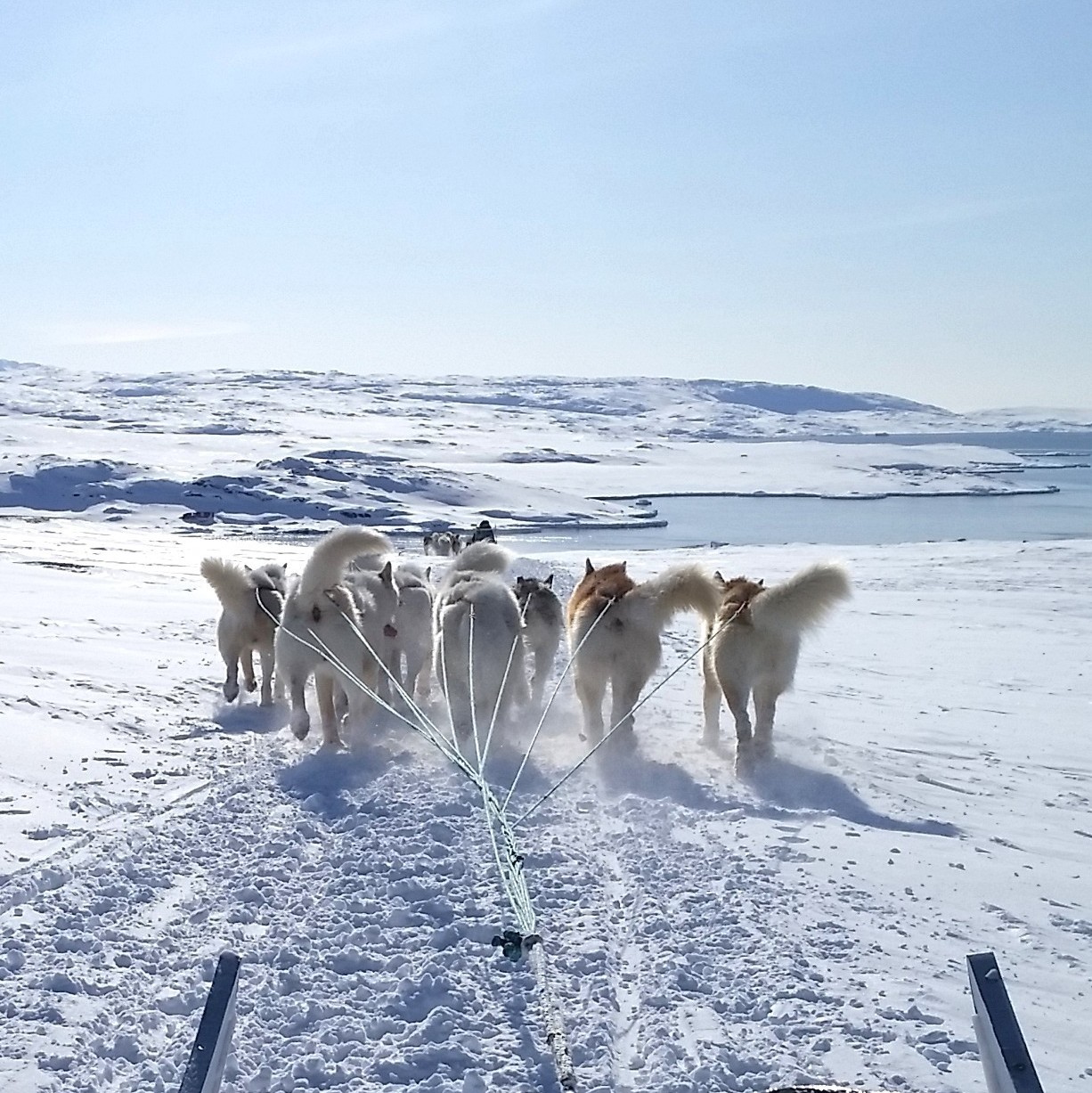
Greenland Sled Dogs (Qimmit) being driven by students at the Qasigiannguit (Greenland) high school in a fan-hitch formation (Photo by Tatiana Feuerborn).
For over 800 years, Greenland’s iconic sled dogs, also known as Qimmit, have been an inseparable companion to the Inuit people, pulling sleds across frozen landscapes and enabling survival in one of Earth’s harshest environments. But today, these remarkable dogs face an uncertain future. Climate change is melting the sea ice they depend on, snowmobiles are replacing dog teams, and their numbers have plummeted from 25,000 in 2002 to just around 13,000 in 2020 [1].
What makes the Qimmit unique among Arctic dog breeds? For nearly a millennium, they have served as sled dogs in the same region, partnering with the same communities. In contrast, other indigenous breeds, such as Siberian Huskies and Alaskan Malamutes, have been extensively crossbred with European dogs or adapted primarily as companions. The Qimmit, however, have remained closely tied to their original working role across Kalaallit Nunaat (Greenland). Our AaRC speaker Dr. Tatiana Feuerborn described how she joined forces with other peers to analyze Qimmit genomic data spanning from 800 years before present to present days [2]. Their findings reveal a population shaped by centuries of isolation, regional differentiation, and remarkable resilience.
A tale of two arrivals
They started by analyzing data from four different regions in Greenland: North (Avanersuaq), Northeast, East (Tunu), and West (Kitaa). Using demographic modeling, they determined that Qimmit probably arrived in Greenland in two distinct waves with the Inuit from Canada. The first wave, arriving around 1,164 years ago, gave rise to the Avanersuaq population, and the now-extinct Northeast population. A second wave, approximately 930 years ago, established the ancestral population that would split into the Kitaa and Tunu populations around 792 years ago. These findings align with archaeological evidence of a three-phase settlement of Greenland by the Inuit [3], and put Qimmit dogs as the oldest known dog breeds [4]. However, they also suggest something intriguing: either the dogs diverged before the settlement, or the Inuit arrival to Greenland occurred more than a century earlier than previously thought.
The lost population
Nevertheless, the most poignant discovery concerns the extinct Qimmit population of Northeast Greenland. The Inuit of this region disappeared following their only recorded contact with Europeans in 1823, leaving no oral histories or human genetic legacy. The dog genomes, however, preserve their story. Dr. Feuerborn and collaborators revealed that the Northeast Qimmit were genetically highly homogeneous, evidencing a small, isolated population. When the region was resettled in 1925 by Inuit from the East, the genetic discontinuity was complete. Today’s Northeast dogs descend from these later arrivals related to the Tunu population, and not the original lineage.
Surviving on the edge
After centuries of isolation, the Qimmit show concerning genetic trends in some regions. As Dr. Feuerborn described, the genetic diversity in Avanersuaq (North region) decreased between 1977 and the present, likely reflecting disease outbreaks including a devastating distemper epidemic that killed ~80% of dogs [2]. In Tunu (East), a similar effect was found through the 19th century, mirroring human population crashes from famine. Fortunately, 20th-century urbanization reversed this, as dogs from small isolated groups migrated to larger settlements, increasing the chances of unrelated mating. Overall, Qimmit’s genetic diversity was comparable to other wild isolated populations like dingoes, but they showed shorter homozygosity segments, indicative of a sustained small population over many generations.
A relatively unaltered lineage
A surprising finding challenged assumptions about colonial influence. Despite over 300 years of Danish-Norwegian presence in Greenland, Dr. Feuerborn highlighted the minimal European dog ancestry present in modern Qimmit. This contrasts sharply with other Arctic breeds. They identified a few heavily admixed individuals, evidencing a distinct dark-furred lineage mostly used for coat fur. But these remained exceptions. The low European dog influence reflects successful early conservation policies that created a protected “sledding district” where only Qimmit dogs were allowed.
More intriguingly, Inuit oral traditions speak of deliberately breeding female dogs with wolves to strengthen their teams. The genetics, however, tell a more complex story. While Arctic dogs do show greater allele sharing with wolves compared to European or African breeds [5], this reflects ancient introgression that occurred before the lineage spread into North America. Additionally, wolves in Greenland are now restricted to northern regions, limiting contact with most Qimmit populations.
A complex crossroads ahead
The Qimmit now stand at a critical juncture. Effective population size estimates show accelerated decline over the past 150 years, and climate change threatens the very foundation of their existence, the sea ice. Shaped by intense natural and human selection for survival in the Arctic and performance as sled dogs, the Qimmit deserve our efforts to ensure they continue their partnership with the Inuit people. As Dr. Feuerborn notes in her paper, this study demonstrates “the relevance of paleogenomic insight into current conversations and decisions centered around conservation and preservation of culturally significant species.”
References
- Sonne, C. et al. Greenland sled dogs at risk of extinction. Science 360: 1080 (2018).
- Feuerborn, T.R. et al. Origins and diversity of Greenland’s Qimmit revealed with genomes of ancient and modern sled dogs. Science 389: 163–168 (2025).
- Mønsted, A. et al. An early Inuit workshop at a Qassi, a men’s house, Nuulliit, Northwest Greenland. Arctic Anthropol 59: 3–38 (2023).
- Guinness World Records, “Oldest dog breed” (2020); https://www.guinnessworldrecords.com/world-records/oldest-dog-breed.html.
- Pilot, M. et al. Widespread, long-term admixture between grey wolves and domestic dogs across Eurasia and its implications for the conservation status of hybrids. Evol Appl 11: 662–680 (2018).
Below, Tatiana shared with us further details about her profile, career, prospects and future projects:
1. Briefly introduce yourself. What is your origin story for how you got into science?
I came to ancient DNA research through a lifelong fascination with dogs. As a child, I wanted to be a veterinarian to work with animals. In school I discovered a love for history and travel. Little did I know as a child that it would be possible one day to studying archaeology and combine these interests. Today, my research focuses on the ancient DNA of Arctic dogs, where my passion for animals, curiosity about human history, and my love of travel and snow are able to come together in my work.
2. How and/or why did you start working on this project?
This project started as part of my PhD thesis that was borne out of a large project on studying the cultural and genetic origin of the Greenland Sled Dog, called the Qimmeq Project.
3. Were there any major challenges in this project? How did you overcome them?
As with all ancient DNA projects there were countless hurdles to overcome in the lab working with the samples. For me personally the biggest challenge was to do justice to the project and dogs that I cared so much about when it came to integrating a large dataset of ancient and modern genomes together and bringing results back to the communities that have cared for these dogs for millennia.
4. What do you think are the main take-home messages of this project?
I hope that this project has brought awareness of the Greenland Sled Dog to the attention of more people as these are such majestic and culturally significant dogs and shown that studying ancient populations can have tangible relevance to populations today.
5. What do you think is missing in the field that you would like to work on?
I would love to expand the research to look across the region to see in other isolated locations the unique histories of other dog populations to explore the dynamic histories of humans and their canine companions.
6. Where do you see yourself in the near future?
In the near future I see myself back in Europe expanding my research into dog history. In fact, I’m starting a new position at the University of Copenhagen and University of Greenland exploring the dogs associated with the Norse in South Greenland and the local Inuit dog populations.