January 2026
Ancient DNA from open-air sites reveals new insights about horse evolution
“Do you give the horse his strength? Do you clothe his neck with a mane? Do you make him leap like the locust? His majestic snorting is terrifying. He paws in the valley and exults in his strength; he goes out to meet the weapons. He laughs at fear and is not dismayed; he does not turn back from the sword.” (From the Book of Job 39:19-25).
The horse legacy
For millennia, humans have celebrated the horse’s power, grace, and fearlessness. The text above captures something profound about these magnificent animals, their strength, their courage, their deep connection to human history. While the book of Job marvels at the power of the horse, long before horses carried riders or pulled chariots, their ancestors were already roaming prehistoric landscapes. The horse family (Equidae) has a fossil history stretching back about 55 million years, making it a key example for studying long-term evolution. Today, only one genus survives, Equus, which includes zebras, donkeys, and horses. However, fossils show that the family was once far more diverse, with more than 35 genera and many species [1]. Although some earlier lineages survived for a long time, most disappeared. As a result, all modern living horses descend from a single Eurasian lineage that originated from this later migration [2]. Our AaRC speaker Arianna Weingarten described how an early visit to a remarkable archeological site shaped her interest for paleogenomics research. Located between the cities of Hannover and Berlin, the place was the Middle Pleistocene open-air site complex of Schöningen in Lower Saxony, Germany, dated to about 320–300 thousand years ago. The site itself tells an extraordinary story: Schöningen is where archaeologists discovered the world’s oldest complete wooden spears, found alongside the butchered remains of 20-25 horses [3,4]. These artifacts provide direct evidence that our ancient hominin ancestors were already sophisticated hunters with complex tools, and horses were central to their survival.
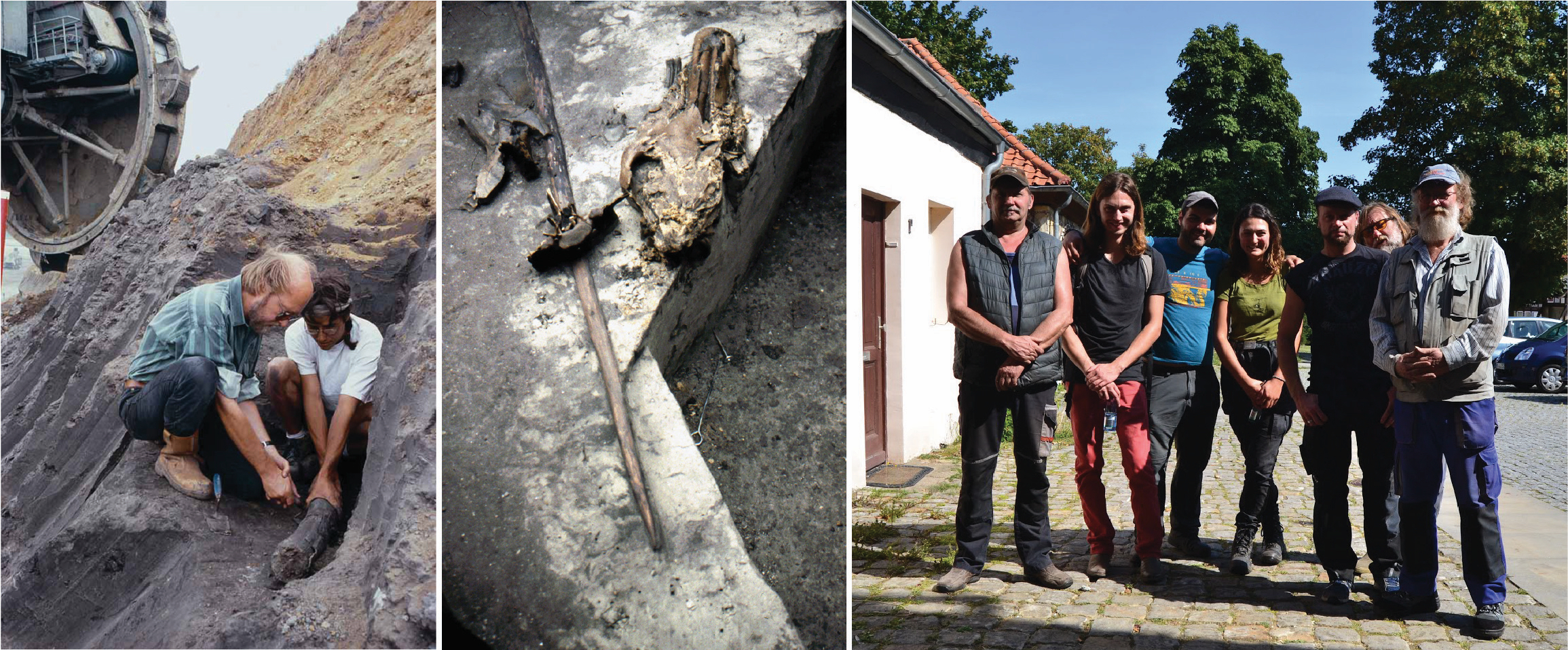
Left: Dr. Hartmut Thieme uncovering an elephant tusk during a rescue excavation (Photo: Peter Pfarr). Middle: A horse skull discovered next to a wooden spear (Photo: Nicholas J. Conard). Right: Arianna during her first excavation at Schöningen with the excavation team and researchers Ivo Verheijen and Gabriele Russo (Photo: Jordi Serangeli).
Pushing the limits of ancient DNA
In their study, Arianna and her collaborators focused on two horse specimens recovered from the site and identified morphologically as Equus mosbachensis [5]. Using petrous bones, which often preserve DNA better than other tissues and bone types, they sequenced their mitochondrial genomes and determined that one individual was male and the other female. Extracting DNA from these Middle Pleistocene remains was particularly challenging. As Arianna described, the genetic material was highly fragmented and chemically damaged. To address this, the authors developed a specific computational method called DORIAN to help detect and down-weight damaged DNA bases [5], thus improving the accuracy of genome reconstruction. The recovery of such ancient mitochondrial genomes extended the known limit of DNA preservation in open-air sites to roughly 300,000 years, demonstrating that favorable environmental conditions can sometimes preserve genetic material almost as well as caves.
Reconstructing the unbroken horse lineage
After such a success, Arianna compared them with more than a hundred ancient and modern horse mitochondrial sequences to assess their evolutionary relationship among past horse lineages. Previous research had established an ancestral clade (B) evolved in North America, which eventually migrated to Eurasia giving rise to two clades (A and C), one of which remigrated to North America during the Late Pleistocene and diversified into two additional clades (A1 and A2) [6]. The large megafaunal extinction of the Early Holocene, however, eventually resulted in the extinction of all these except for clade A, which gave rise to all modern horses [6]. Phylogenetic analyses carried out in this study showed that the two Schöningen horses occupy a basal position relative to the diversification of modern horses within clade A [5]. In simple terms, their maternal lineages split off very early from the clade that eventually led to living horses. Arianna and her collaborators also used molecular dating of the mitochondrial genomes, and determined the age of one of them to be around 360,000-years-old [5]. Moreover, they even estimated that the ancestral mitochondrial clade B diverged around 800,000 years ago from A and C clades, and that the A clade diverged from their ancient Schöningen horses around 570,000 years ago. The authors further report that a major diversification within extant clade A likely began after roughly 230,000 years ago, a period overlapping with an interglacial phase that may have influenced equine evolution through environmental change [5].
New tools for new challenges
As Arianna finally highlights, their study shows how technological advances tailored for deep time remains are transforming the palaeogenetics field. Their innovative methods helped reducing bias and recovering more usable data from highly degraded samples. This study not only extends the timeline of what is possible in DNA recovery from open-air sites but also provides crucial data points for reconstructing horse evolution during a period that left few genetic traces.
References
- MacFadden, B.J. & Hulbert, R.C. Explosive speciation at the base of the adaptive radiation of Miocene grazing horses. Nature 336: 466–468 (1988).
- Rook, L. et al. Mammal biochronology (Land Mammal Ages) Around the world from Late Miocene to Middle Pleistocene and major events in horse evolutionary history. Front Ecol Evol 7: 278 (2019).
- Hutson, J.M. et al. Persistent predators: Zooarchaeological evidence for specialized horse hunting at Schöningen 13II-4. J Hum Evol 196: 103590 (2024).
- Hutson, J.M. et al. Revised age for Schöningen hunting spears indicates intensification of Neanderthal cooperative behavior around 200,000 years ago. Sci Adv 11: eadv0752 (2025).
- Weingarten, A. et al. Mitochondrial genomes of Middle Pleistocene horses from the open-air site complex of Schöningen. Nat Ecol Evol 9: 2248 (2025).
- Vershinina, A.O. et al. Ancient horse genomes reveal the timing and extent of dispersals across the Bering Land Bridge. Mol Ecol 30: 6144–6161 (2021).
Below, Arianna shared with us further details about her profile, career, prospects and future projects:
1. Briefly introduce yourself. What is your origin story for how you got into science?
I completed my undergraduate studies at the University of California, Santa Cruz without arriving with a plan to become a scientist. Instead of following a lifelong passion or being pushed to choose a subject early on, I was fortunate to have the freedom to explore different disciplines and gradually discover what I was interested in. I kept taking biology classes because it seemed like important knowledge for navigating the world, while geology classes drew me in with their field trips around California. This mix of practicality and curiosity eventually led me to a double major in biology and a combined anthropology/earth science degree. Somewhere along the way, I was introduced to ancient DNA and was immediately fascinated because it combined my interests of deep-time, geology, archaeology, and biology. This led me to my current position as a PhD student in the Archaeo-and Palaeogenetics group at the University of Tübingen.
2. How and/or why did you start working on this project?
I actually started this project during my master’s degree, after I went on excavation at Schöningen. At the time there had been a few unpublished attempts at retrieving ancient DNA from the site. The project originated as my master’s thesis, in which we applied the most up-to-date sampling and laboratory protocols, and surprisingly, got some promising results! Building off this initial shotgun screening, my PhD research expanded the work by producing mitochondrial baits in-house and performing mitochondrial capture experiments to investigate a few species from the site. Though only the horse story is out at the moment!
3. Were there any major challenges in this project? How did you overcome them?
Definitely. One of the major challenges was deciding how to best move forward with the data we generated. The extremely high damage in the samples, paired with the very short fragment lengths, meant that decisions about cut-off thresholds and how to handle damage had a large impact on the reconstruction of the mitogenomes. To deal with this we carried out extensive testing using different software tools and custom scripts. Ultimately, we established a collaboration with bioinformaticians at the University of Tübingen to develop a tool for our data (and similar data types!), which allowed us to keep the maximum amount of reliable information in our downstream analysis for molecular dating and phylogenetic work.
4. What do you think are the main take-home messages of this project?
The main take-home message of the project is the opportunity for discovery that comes from pushing the boundaries of how far back in time, and across which environmental contexts, genetic data can be retrieved from the fossil record. However, this effort definitely requires keeping in mind a number of caveats, including rigorous data screening to ensure that the reconstructed genomes reflect true biological variation. Overall, it’s a little bit high risk, high reward but that’s also what’s exciting.
5. What do you think is missing in the field that you would like to work on?
I’m really interested in the exploratory side of the field, so working with previously unknown genomes and stitching together paleontological, archeological, and genetic information. There are still so many extinct species that remain genetically unexplored. Expanding ancient genomic data, especially on the whole-genome-level, can provide a view into past adaptations and population dynamics and I would like to contribute to developing and applying these approaches.
6. Where do you see yourself in the near future?
Since I’m at the end of my PhD, the near future looks like an intense final period, a hopefully not too horrible ending, followed by a dreamy vacation, and then on to the next adventure!
7. Free space to tell something you would like to remark.
Thanks again for the invite :)